
Old Town, Newbury the best example of truly regenerative town centre development taking place in Britain today
By Niki Hinman Local Democracy Reporter
Published: 05:55, 15 April 2026
The developer behind the mews house quarter planned for the Kennet Shopping centre site in Newbury town centre has been detailing security plans for the site.
The so-called Old Town quarter will replace the old, covered mall area – with planning permission given by the district council last year.
Thames Valley Police says the design could, in places, create anti-social behaviour.

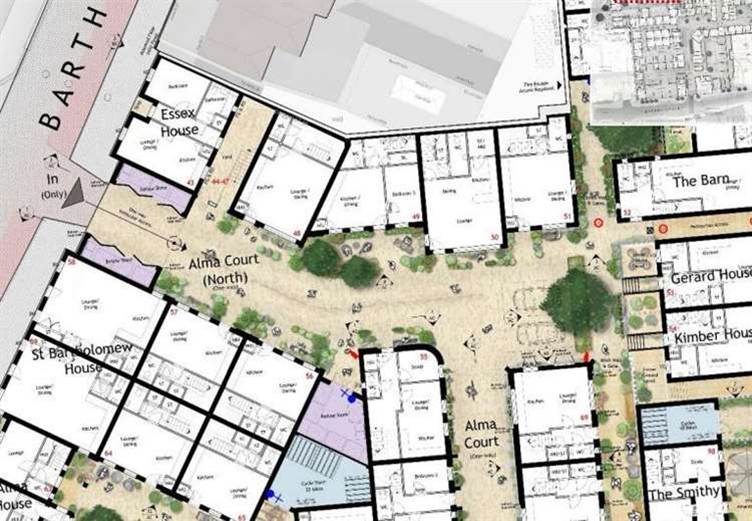
One area of the site – Ashton Thicket – is open at all times as it provides an east-west link through the site.
“We had proposed that the dwellings fronting Ashton Thicket could have small benches to the front of their dwellings, along with potted plants etc,” says developer Lochailort, which has also released more drawings of what the area could look like.
“However, we agree that the benches may promote antisocial behaviour as the public passing through may confuse private benches with public benches.
“Therefore, we propose to remove these benches and replace them with pot plants.

Impression of street view with lighting design
“We agree that, ideally, the frontage of dwellings should be afforded a defendable space, and we have sought to deliver that by way of landscaping where appropriate.
“Excellent examples of successful landscaping (including benches) being used at the front of dwellings to deliver defendable space and amenity space.

“The design team researched successful, award-winning, urban environments, with examples contained within the statement.
“For example, Figure 1 below illustrates a view through a ginnel of a linear yard, not too dissimilar to the proposed scheme.
“The use of benches, potted plants and large green verticality offers and determines the defendable space while creating a communal (public) space beyond.
“These not only cover the longer ginnels/passageways, but they also cover the majority of the spaces created, offering a further layer of resident reassurance, security and deterrence.”

The gates to the ginnels and small passageways will be permanently locked.
Only those residents who live in a particular court/yard/place/mews will have access to the gates that secure their particular court.
For example, residents of Eagle Court will have access to the gate to the east (on to Market Place) and the gate to the west (to Artist Mews) and the south (to Falkland Place).
This, say the architects, will compartmentalise the spaces into more secure and exclusive places, which will “achieve a stronger sense of localised community, belonging and identity”.
Each gate will have an electronic interface to allow visitors to ‘ring’ for a dwelling and/or call the concierge.
The electronic interface will also allow residents to enter a code to release the gate, or they can use a fob.
Each gate will be linked to the over-arching security system so that the gates will become unlocked as soon as a fire alarm is triggered.
Alma Court will be ‘open’ at all times.
However, the passageways/ ginnels that provide pedestrian access to neighbouring courts will have a lockable gates that will only restrict non-resident access between the hours of 9pm to 7am.
“The courts and yards form part of the amenity provision for the dwellings, therefore, we want to balance public permeability with privacy,” says Lochailort, but the CCTV plan will also see cameras trained along the alleys.
The council has also insisted that no above ground construction shall take place until a sample panel of the materials to be used in the construction of the external surfaces/roofing/brickwork/stonework shall have been prepared on site for inspection and approved.
A scheme for protecting the proposed dwellings of the approved development from road and entertainment noise from the town centre night-time economy also has to be submitted, along with a scheme of works to minimise the emission of cooking odours.
The scheme as a whole gets a glowing appreciation from Create Streets, a town-builder/think tank.
“Over the last century, many of our town centres ‘went wrong’ as they ‘zoned’ residents out of towns and tried to reinvent themselves as purely retail or commercial zones,” says Nicholas Boys Smith, founder and chairman of Create Streets.
“This approach has proved deeply irresilient and unsustainable.
“Town centres need people living in them and aspiring to live in them if they are to weather the unknowable storms of the future.
“With West Berkshire’s housing target increasing 118 per cent from 495 to 1,078 and with a very generous supply of shops nearby, creating 317 new homes will provide nearly 30 per cent of the local council’s housing requirement.
“It will also provide customers and footfall for local shops and restaurants, potentially around £5m of per annum local retail spend as well as a wider boost to the local economy.
“This is an exemplary ‘gentle density’, centripetal not centrifugal, development which is good for people, prosperity and the landscape.
“Old Town, Newbury is very probably the best example of truly regenerative town centre development taking place anywhere in Britain today.”